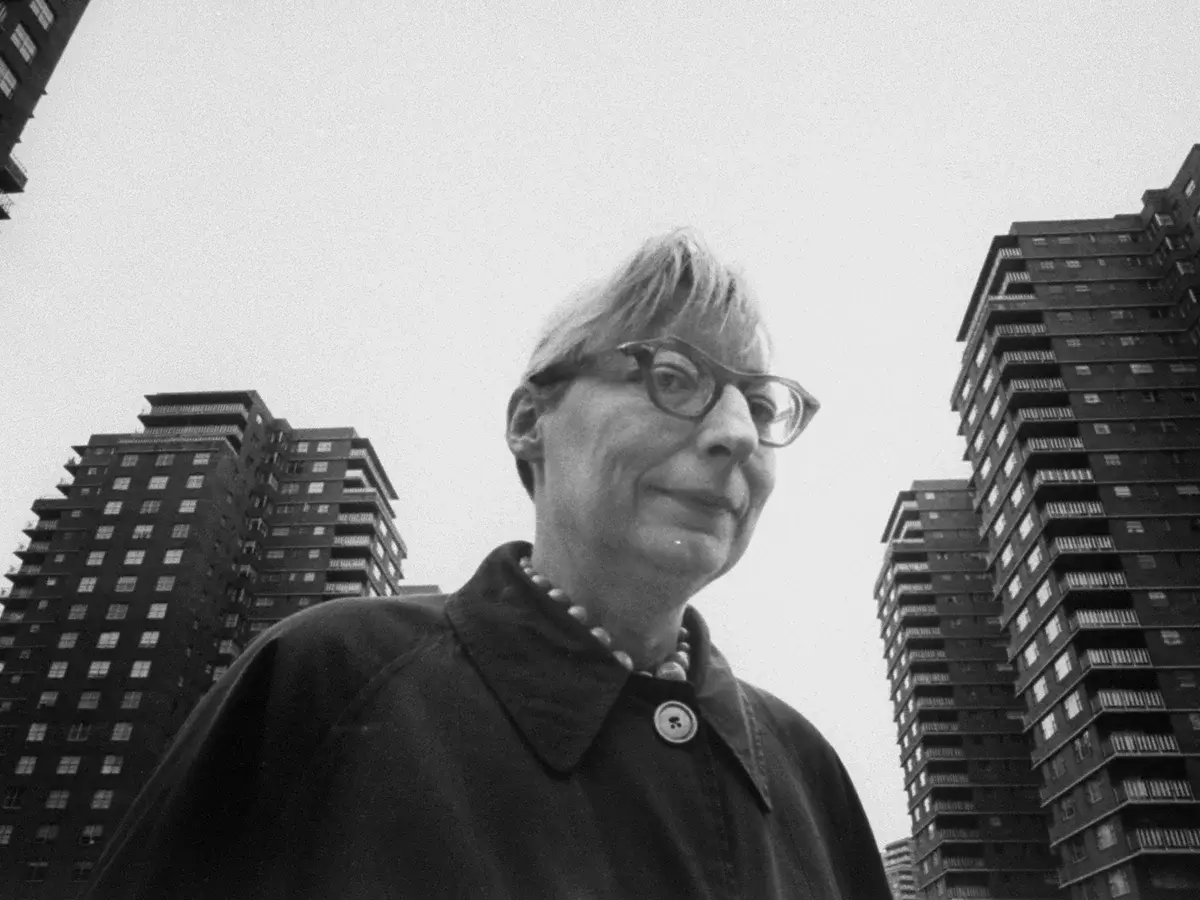
Jane Jacobs was not an architect. This is worth stating clearly, because the resentment her work provoked in the architectural and planning professions was partly a reaction to its source.
She was a journalist, initially, and then a writer and activist, living in Greenwich Village in New York in the 1950s and 60s. She had no formal training in urban planning, no academic credentials in architecture or sociology. What she had was an unusual capacity for observation, a willingness to take seriously what she saw rather than what theory told her to expect, and a prose style of sufficient force to make planners uncomfortable for the rest of their careers.
The Death and Life of Great American Cities, published in 1961, is an attack on the planning consensus of its era. That consensus, which had been building since the early twentieth century and had reached its most powerful expression in the postwar urban renewal programmes of American cities, held that the traditional dense mixed-use city was essentially a slum that needed to be cleared and replaced with something more rational: towers in parkland, superblocks free from the chaos of traditional street grids, separation of uses so that residential areas were free from the noise and disorder of commerce and industry.
Jacobs had watched this theory being applied to New York and observed that the results were consistently the opposite of what the planners intended. The housing projects built to replace the old neighborhoods were less safe, less economically vital, and less socially coherent than the neighborhoods they had replaced. The towers in parks created dead space that invited crime. The separation of uses produced districts that were active only at certain hours and empty at others, which was precisely the condition that allowed crime to flourish.
Her explanation of why the old neighborhoods worked and why the planned replacements did not rested on four conditions she identified as necessary for urban vitality. Districts needed to serve more than one primary function, so that people were present throughout the day for different reasons. Blocks needed to be short to allow pedestrians multiple routes and to prevent any section of the street from becoming a dead end. Buildings needed to vary in age and condition, because new buildings could only be afforded by enterprises with high profit margins, while the economic diversity of a neighborhood depended on older buildings with lower rents. And density needed to be sufficient to support the diversity of uses that vitality required.
These are not aesthetic observations. They are functional ones, derived from observing what actually happened in streets, blocks, and neighborhoods rather than from any theoretical model of how they ought to behave. This is what made Jacobs's work so threatening to the planning profession: she was using their own criteria, safety, economic vitality, social cohesion, to demonstrate that their interventions were producing the opposite of what they claimed.
The accusation that was most commonly leveled at Jacobs by her critics was that she was a conservative: that her defense of traditional urbanism was essentially a defense of the status quo, of existing neighborhoods and their existing residents against the progressive project of urban renewal. This accusation missed the point almost entirely. Jacobs was not defending the status quo. She was defending the complexity and self-organizing capacity of urban life against the hubris of planners who believed they could produce better outcomes by replacing complexity with order.
Her influence on subsequent urban planning and design has been pervasive, though not always acknowledged. The principles she identified in 1961 are now the basis of most serious thinking about urban design: mixed use, fine grain, active frontages, density. New Urbanism in America, the urban renaissance in Britain, the contemporary emphasis on walkability and public space: all of these draw on insights that Jacobs articulated in Greenwich Village six decades ago.
What Jacobs understood that her contemporaries did not was that cities are not machines. They are ecosystems: complex, self-organizing, adaptive systems that work through the interaction of many independent actors rather than the implementation of a central plan. The planner's instinct to simplify, to separate, to rationalize, was precisely the instinct most destructive to the processes that make cities function.
She was also right about something more fundamental: that the people who live in a neighborhood know things about it that outside experts do not, and that those things matter to its functioning. The communities that resisted urban renewal, that fought to preserve their streets and buildings against the bulldozer, were not being sentimental or obstructionist. They were defending a complex social ecology that the planners, looking at maps and statistics, could not see.
Sixty years later, the argument she made has not been superseded. It has been repeatedly confirmed by the failure of the planning theories she opposed and the success of the urbanism she defended.
She was right. The city knew what it was doing. It needed someone to say so.