A square is a city's statement of intent.
It is the space a city sets aside from the business of movement and commerce and says: here, people may gather. Here, things may be witnessed. Here, the public life of the city is permitted to constitute itself as something more than the sum of private transactions. Every significant civic square in history has been, in this sense, a political act before it was an architectural one. The decision to make a square is a decision about what a city believes it is for.
The Piazza San Marco in Venice is the most celebrated square in the world, and it earns that distinction. Napoleon, who had seen everything, called it the drawing room of Europe, and the description captures something real about the quality of the space: it has the proportions and the sense of enclosure of a room, but it is open to the sky, and the sky over Venice at dusk turns the whole composition, the Basilica, the Campanile, the Procuratie that line three sides of the square, into something that no interior could replicate. The square was not designed in a single act. It accumulated over several centuries, each addition responding to and reinforcing the whole. The result is one of the most complex and successful pieces of urban design in human history, and it looks effortless.
The effortlessness is the trick. The greatest public squares make their spatial achievements appear inevitable, as though the space could not have been any other shape or any other size. The Piazza del Campo in Siena, the gently sloping shell-shaped square that has hosted the Palio horse race twice a year since the fourteenth century, has a geometry so precisely calibrated to the hillside it occupies that it seems to have been found rather than made. The Campo is the center of Sienese civic life not because it was designated as such by a planner but because its spatial quality made it the natural location for everything the city needed to do in public.
Power has always understood the potential of the public square. Haussmann's rebuilding of Paris under Napoleon III in the 1860s created, among many other things, the Place de l'Opéra, designed to terminate the Boulevard des Capucines with a monumental closure that leaves no doubt about who is in charge of the city. Red Square in Moscow was used by every Soviet government for military parades that were, in their meticulous staging, essentially theatrical productions: the square as stage set for the performance of state power. Tiananmen Square in Beijing, the largest public square in the world, is so large that it defeats the human scale entirely, which is presumably the intention: a space in which the individual is reduced to an element in a composition whose scale is the scale of the state.
These are cautionary examples, not because they fail as architecture but because they succeed so completely as instruments of control. A square designed to make people feel small, to prevent the spontaneous assembly of crowds into anything resembling community, is a square that has been weaponized against the city it sits in. The distinction between a public square and a parade ground is not a question of size but of intent: does the space enable the public life of the city, or does it stage the power of the state?
The best contemporary squares are being made in cities that are rethinking their relationship to public space after decades of treating it as residual: the leftover territory between buildings and roads. The Superkilen park in Copenhagen, completed in 2012 by BIG, Topotek1, and Superflex, consists of three squares in sequence, each with a distinct character, populated with objects collected from the countries of origin of the neighborhood's immigrant residents. A Moroccan fountain sits next to a Thai boxing ring next to a Russian manhole cover. The square is explicitly a statement about who belongs in the city and whose presence is acknowledged.
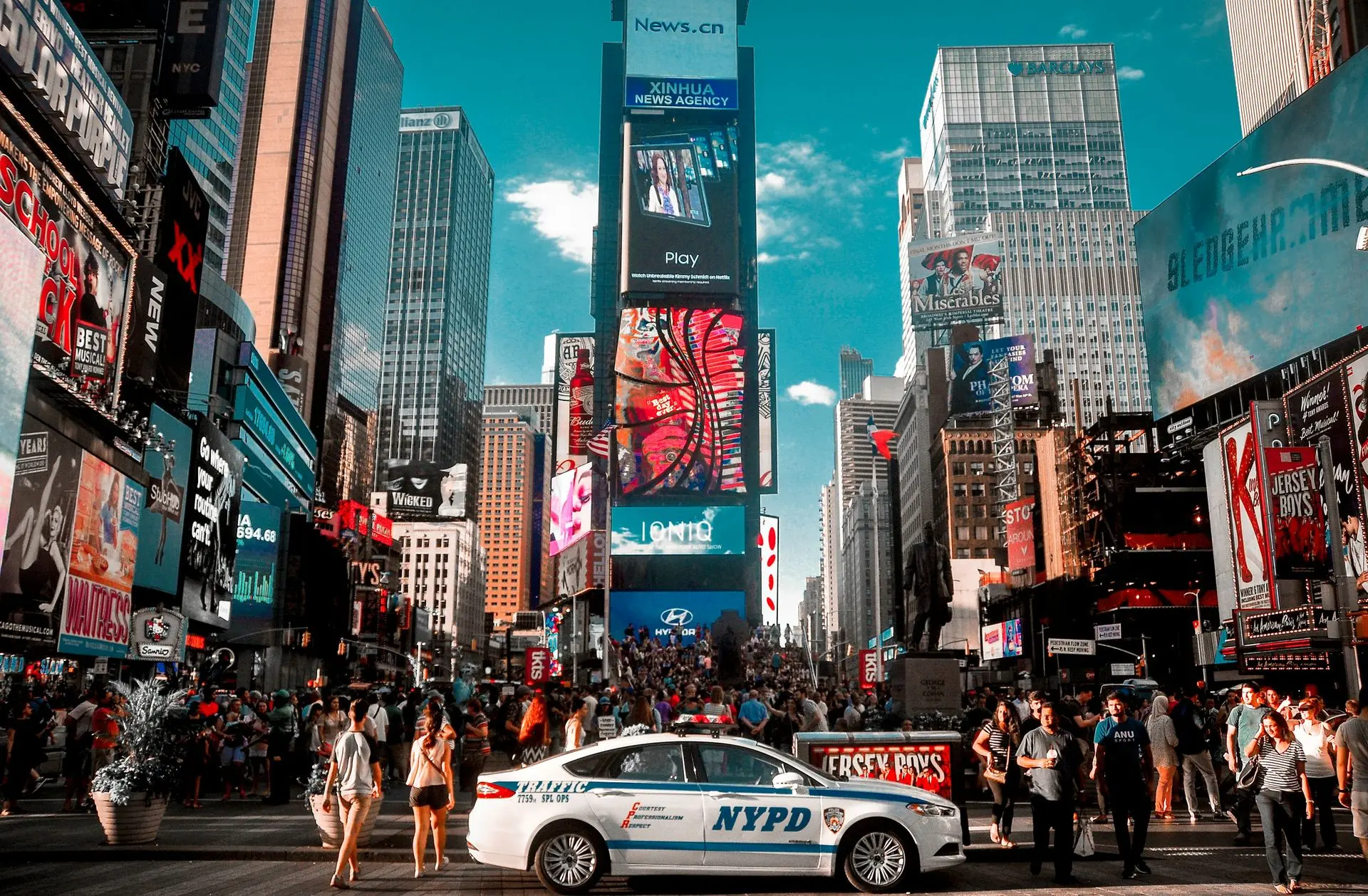
The redesign of Times Square in New York, which began with the pedestrianization of the central section of Broadway in 2009, is a more straightforward but equally significant intervention. Before the pedestrianization, Times Square was primarily a traffic interchange with some buildings attached. It is now, imperfectly and chaotically but genuinely, a public square: a place where people come to be in public together rather than merely passing through.
What both examples have in common is an understanding that a square is not a space left over after the buildings are placed. It is a positive spatial decision, as considered and as consequential as any building on the city block. The void is as important as the solid. The space between things is the thing itself.
Cities that understand this produce civic life. Cities that do not produce car parks.
The square is where the city goes to be itself. It deserves to be designed as carefully as anything the city builds.