There are two ways to think about a historic building. They are fundamentally incompatible, and architects have been arguing about them for a hundred and fifty years.
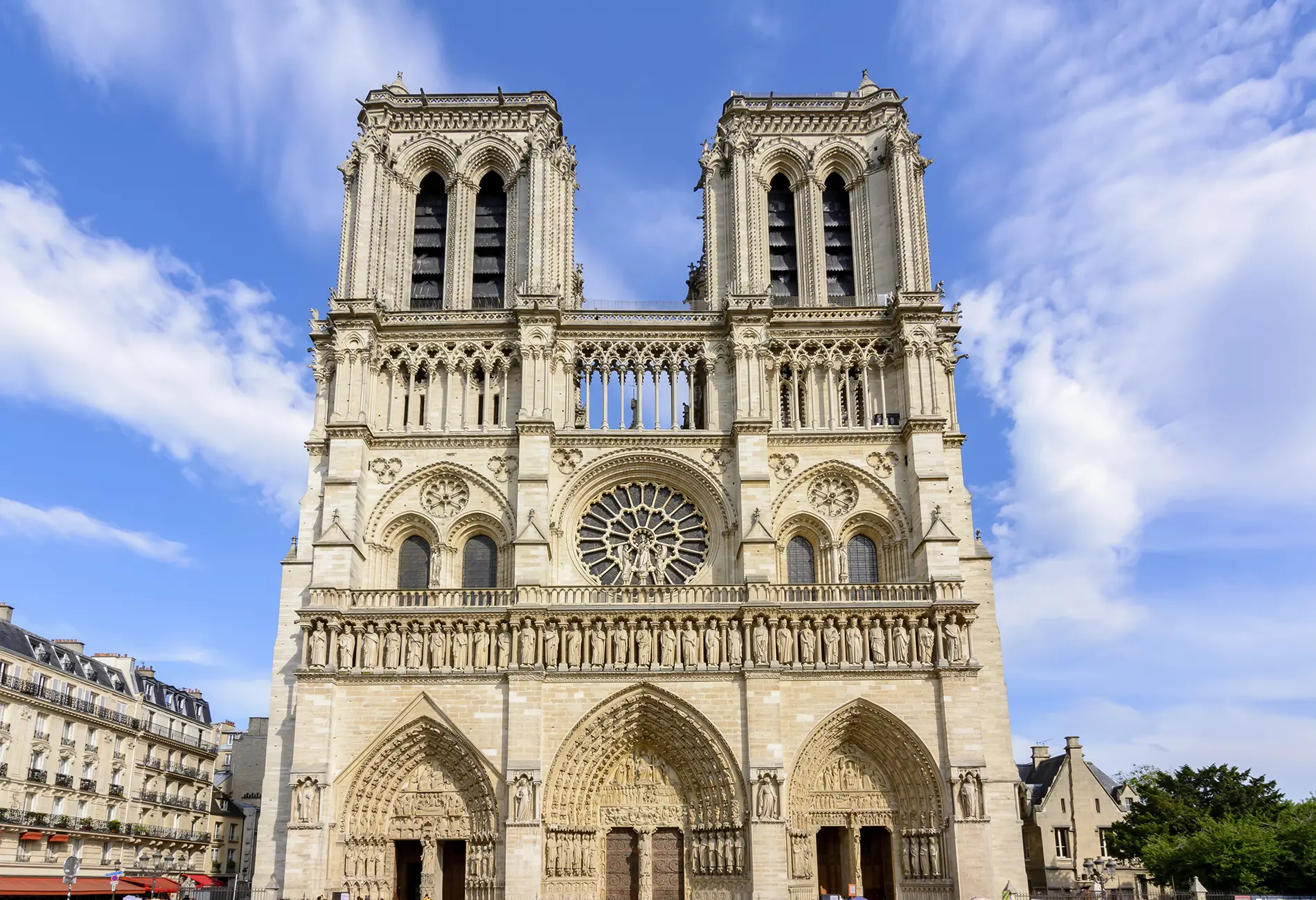
The first position is associated with Eugène Viollet-le-Duc, the nineteenth-century French architect who restored, or in some cases essentially rebuilt, many of the most significant medieval buildings in France, including the walled city of Carcassonne, the Basilica of Vézelay, and Notre-Dame de Paris. Viollet-le-Duc's approach was interventionist: he believed that the purpose of restoration was to return a building to a complete state, and that this might require adding elements that had never existed in the building's actual history but which the architect could deduce, from historical research and structural logic, ought to have existed.
The most famous expression of this position is his definition of restoration in the Dictionnaire raisonné de l'architecture française, published between 1854 and 1868: to restore a building is not to maintain it, to repair it, or to rebuild it; it is to re-establish it in a complete state which may never have actually existed at any given moment. This is an extraordinary statement, and its implications are radical: the restored building is not a recovered past but a constructed ideal, an architect's hypothesis about what the building should have been rather than a record of what it was.
The second position is associated with John Ruskin, whose Seven Lamps of Architecture, published in 1849, argued that the authenticity of a historic building resided in its original material, and that this material could not be replaced without destroying the building's essential quality. For Ruskin, the patina of age, the accumulated evidence of the building's history in its very fabric, was not incidental to its significance but constitutive of it. A restored building was a lie: it presented itself as something it was not, denying the history that had actually occurred and replacing it with a fiction of completeness.
The debate has continued in modified forms ever since. The Venice Charter of 1964, the international document that established the modern principles of conservation practice, attempted a compromise: authentic historic material should be retained wherever possible, but new additions should be distinguishable from original fabric. The building should read as what it is: a historic structure that has been maintained and, where necessary, supplemented, rather than either a pristine original or a complete reconstruction.
In practice, the Venice Charter principles have proved difficult to apply consistently. Every conservation project involves judgments about where the line falls between acceptable intervention and unacceptable alteration, and these judgments are contested. The restoration of the Acropolis monuments in Athens has involved the replacement of deteriorated marble with new material matched as closely as possible to the original, the reassembly of fallen fragments, and the reconstruction of elements whose original form is known from historical records. Purists argue that the reassembled Parthenon is a modern construction masquerading as an ancient one. Pragmatists argue that without intervention the monuments would continue to deteriorate toward illegibility.
The fire at Notre-Dame de Paris in April 2019, which destroyed the nineteenth-century spire and the medieval roof structure, brought the debate into sharp contemporary focus. The French government's initial commitment to rebuild the cathedral exactly as it was before the fire, including the reconstruction of Viollet-le-Duc's spire, was later modified to allow a competition that selected a design that restored the lost elements in their pre-fire form. The rebuilt spire, completed in 2024, is a Viollet-le-Duc reconstruction of a Viollet-le-Duc reconstruction: an almost vertiginously recursive act of architectural memory.
The most interesting contemporary conservation projects are those that treat the tension between authenticity and intervention not as a problem to be solved but as a productive condition to be explored. David Chipperfield's Neues Museum in Berlin, completed in 2009 after decades of war damage and postwar neglect, retained the ruins of the original building and integrated new construction that is clearly distinguishable in material and detailing from the historic fabric. The result is a building in which the history of its own destruction is legible alongside the original architecture: the war damage is not hidden but incorporated, as evidence of what the building has lived through.
This approach treats the building as a document of its own history, as something that has been in the world and has been changed by that experience, rather than as an ideal form to be recovered. It is the most honest of the available positions and, in the right hands, also the most architecturally interesting.
The debate between Viollet-le-Duc and Ruskin is not resolvable because it reflects a genuine tension between two legitimate values: completeness and legibility, and authenticity and material truth. Every conservation project must negotiate this tension, and the negotiation is never quite the same twice.
This is not a weakness of the field. It is its intellectual richness.