Lina Bo Bardi believed that beauty was not a luxury.
This sounds like a simple statement. In the context of twentieth-century architecture, in the context of Brazil in the 1950s, 60s, and 70s, and in the context of a woman working in a profession that barely acknowledged her existence, it was a radical one. Beauty as a democratic right, not as class privilege. Architecture is not the preserve of wealthy patrons or enlightened institutions, but rather something ordinary people are entitled to inhabit and claim as their own.
Bo Bardi was born in Rome in 1914 and trained as an architect in Milan, working in the studio of Gio Ponti before moving to Brazil with her husband Pietro Maria Bardi in 1946. She never went back. Brazil became her country, her material, her obsession, and the place where she did the work that matters.
The building that made her reputation internationally, though it took decades for that reputation to fully form, is the São Paulo Museum of Art (MASP), completed in 1968. It sits on Avenida Paulista, São Paulo's central boulevard, and its most immediately striking feature is structural: the entire building is suspended from four concrete beams at the corners, leaving the ground floor completely open. The structure reads as a glass box floating above a vast covered public square. On Sunday mornings, that square fills with an antiques market. On other days, it is used for political demonstrations, concerts, festivals, and ordinary people passing through.
This was not an accident. Bo Bardi designed the open ground floor precisely so that the building would give something back to the city. In the conventional model, a museum turns its back on the street. It presents a facade and an entrance and expects you to approach it on its own terms. MASP refuses this. It opens itself to the pavement and invites the street in.
Inside, her approach to displaying art was equally unconventional. Rather than hanging paintings on walls in the manner of every European museum, she suspended them on glass easels in the center of the galleries, so that visitors could walk around each work and see the back of the canvas alongside the front. The paintings were labeled on the reverse, with information about their provenance and condition, as well as their art-historical context. The museum presented art as a living object rather than a sacred relic.
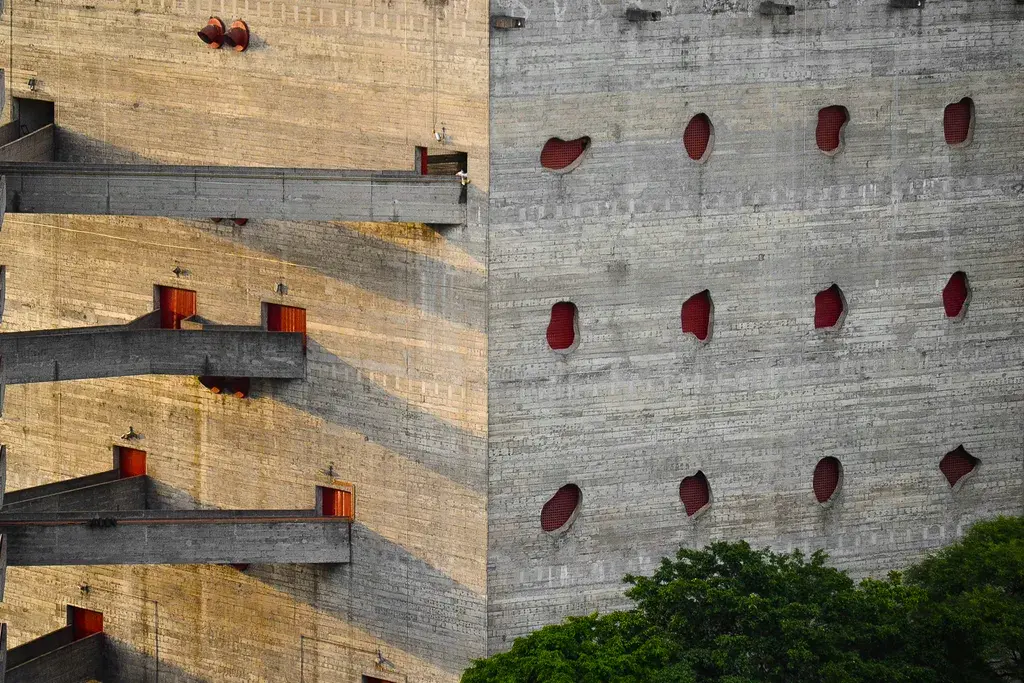
This philosophy of openness, of refusing to make culture intimidating, runs through everything she built. The SESC Pompéia leisure center in São Paulo, completed in stages between 1977 and 1986, was built inside a former drum factory in a working-class neighborhood. Bo Bardi kept the original industrial structure, adding new concrete towers for sports facilities connected by dramatic elevated walkways. The result is a building that feels improvised and inevitable at the same time, as though it grew from the neighborhood rather than being placed upon it. The people who use it are overwhelmingly from the local community. This was the point.
Bo Bardi's relationship with popular culture, craft traditions of the Brazilian northeast, vernacular, and the handmade set her apart from virtually every modernist architect of her generation. While her European contemporaries were pursuing a universal machine aesthetic that deliberately erased local particularity, Bo Bardi was going in the opposite direction: deeper into the specific, the regional, the impure. She collected popular art and folk objects with the same seriousness that European collectors applied to old masters. She wrote about the culture of the Brazilian sertão with the attention of an anthropologist and the affection of someone who had found, in a country not her own, a set of values she believed in more than her own.
She designed furniture, costumes, theatre sets, and exhibitions. She wrote constantly. She was involved in the political and cultural life of Brazil in ways that put her at risk during the military dictatorship, which governed the country from 1964 to 1985. Her SESC Pompéia commission came in part because the organization was one of the few cultural institutions with sufficient independence to work with an architect whose politics made others nervous.
Bo Bardi died in 1992, having spent her final years fighting to preserve the buildings that the city of São Paulo seemed determined to neglect. MASP had leaked for years. SESC Pompéia required constant advocacy. She was not honored as her male contemporaries were. The Pritzker Prize, architecture's highest honor, has never been awarded to a woman alone, and Bo Bardi, who died before the prize had begun to reckon with its own blind spots, never received it.
She is being recovered now, slowly and imperfectly. Her archives are being cataloged. Her buildings are being maintained. A new generation of architects, many of them from the Global South, have found in her work a model for practice that takes seriously the political dimensions of what architecture is for and who it serves.
Beauty as a democratic right. It turns out to be not such a simple statement after all.