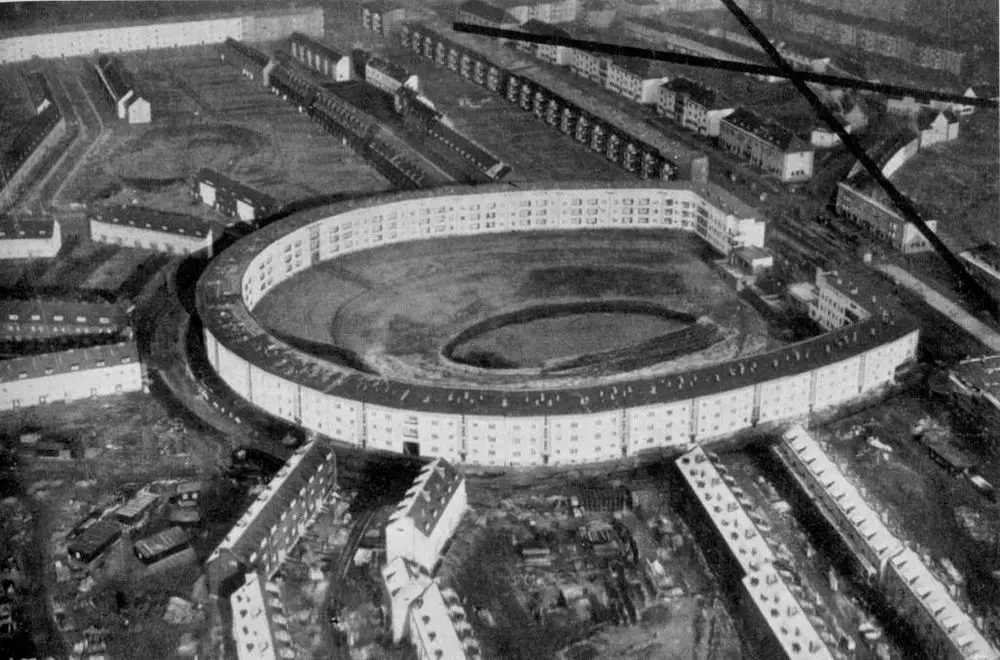
There was a moment, brief and now almost unimaginable, when the idea of mass social housing was genuinely exciting.
Not just as a welfare project, though it was that. Not just as a response to overcrowding and slum conditions, though it addressed those, too. But as an architectural project, it is a serious and sustained attempt to apply the best available design thinking to the question of how ordinary working people should live. The architects involved were not second-tier practitioners. They were the leading figures of their generation, and they brought to the problem of housing the same seriousness they would have brought to a cathedral or a parliament.
The Siedlungen of Weimar Germany, built primarily in Frankfurt and Berlin between 1925 and 1933, are the clearest example of this ambition at its most coherent. Ernst May in Frankfurt and Bruno Taut in Berlin led housing construction programs that built tens of thousands of apartments across both cities in less than a decade. The buildings were low-rise, arranged around communal gardens and shared spaces. Each apartment was designed with the same care as a private house: standardized kitchens developed through ergonomic research, generous windows to admit light and air, and access to outdoor space for every resident. May hired Margarete Schütte-Lihotzky to design the Frankfurt Kitchen, the first fully rationalized domestic kitchen, which became the template for kitchen design worldwide.
The political project was explicit. May and Taut, along with their colleagues, believed that the quality of a worker's home had direct consequences for the quality of a worker's life and, by extension, for the political health of society. Slums produced despair and radicalism, in both reactionary and progressive directions. Well-designed housing produced citizens who could participate in democracy with the dignity that democracy required. This was not sentimental. It was a theory of urbanism with genuine intellectual foundations.
The Frankfurt program ended when May left for the Soviet Union in 1930, having sensed which way the political wind was blowing in Germany. The Siedlungen he left behind were taken over by the Nazi government, which found them too modern and too associated with the socialist politics that had produced them, and proceeded to ignore them. They survived the war and are now listed as World Heritage Sites.
In Britain, the postwar council housing program produced buildings of remarkable range and ambition. The London County Council Architects Department, under the successive direction of Leslie Martin and Hubert Bennett, employed hundreds of architects and produced housing that would today be recognized as significant work if it had been built for private clients. Alton West in Roehampton, completed in 1959, arranged point blocks and slab blocks in a parkland setting modeled on Le Corbusier's Unité, with landscaping by the LCC Parks Department that remains extraordinary. The Powell and Moya Churchill Gardens estate in Pimlico, completed in phases from 1950, was heated by waste heat from the neighboring Battersea Power Station: an early example of district heating that was both technologically innovative and genuinely functional.
The French grands ensembles, the vast housing estates built in the banlieues of Paris and other major cities from the 1950s to the 1970s, were the most ambitious and the most troubled of the European social housing programs. Buildings of genuine architectural quality, designed by architects of genuine talent, were placed in locations that had no infrastructure, no transport connections, no shops or schools or employment. The architectural project was serious. The urban planning that surrounded it was not.
This is the central lesson of the social housing era. The buildings themselves were, very often, genuinely good. The Smithsons' Robin Hood Gardens, demolished in 2017 despite sustained protest, was designed with care and intelligence. Its street decks, meant to recreate the social life of the traditional street at height, were an idea with genuine merit. What failed was not the architecture but the context: the maintenance regimes that were never funded, the community facilities that were never built, the economic investment that never arrived.
To demolish a building because the surrounding systems failed it is a form of scapegoating. It is easier to tear down a tower than to address the housing benefit reforms, the employment policies, and the council budget cuts that produced the conditions the tower is blamed for. The concrete becomes the problem because it is visible, while the policy is not.
What was lost in the demolitions of the 1980s, 90s, and 2000s was not merely buildings. It was the physical evidence of a period when architecture took seriously the idea that working people deserved more than the minimum. That evidence is now almost gone. What remains, in the Siedlungen and Alton West and the surviving grands ensembles, is enough to show what was possible. It does not show what was wasted.
The state once tried to house its people beautifully. It is worth understanding why it stopped.